Last Run - B&A Passenger Train - September 4, 1961
"During August, 1961, the two passenger trains averaged eight revenue passengers a day."
From 1891 to 1961 - over 70 years - the Bangor and Aroostook Railroad ran passenger trains. By 1961 the railroad traffic boom caused by the rationing during World War II was more than a decade behind us and the automobile had clearly taken hold as the method of passenger travel of choice. When the Maine Central ended its rail service in September of 1960, the B&A would get you as far as Northern Maine Junction and then get you to the bus station via either taxi or bus. The days of passenger trains in Northern Maine were numbered.
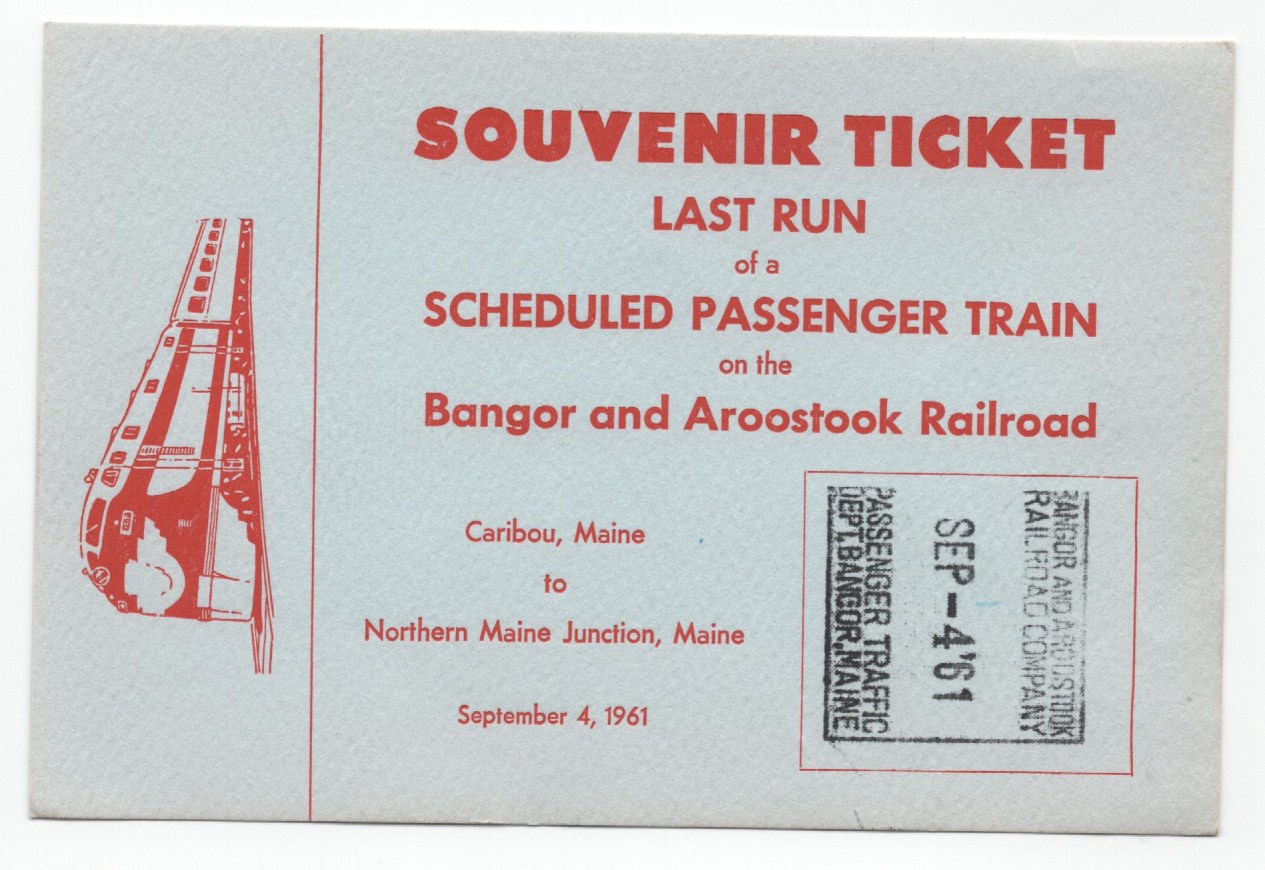
Below you will find one of the tickets handed out to those who rode the last train and the text from articles from the September-October 1961 Maine Line News. You can find the entire issue, including the photos, in the Archives on this site.
All BAR Rail Passenger Service
Ceases Sept. 4 After 68 Years;
Busses to Handle All Passengers
All rail passenger service on the Bangor and Aroostook ceased at the end of the day's operations Sept. 4. It marked the end of all rail passenger service by Maine railroads. The Maine Central Railroad discontinued its passenger service in September of 1960. Since that time, the Bangor and Aroostook's rail passenger service has been without rail connections, originating at Northern Maine Junction and ending at Caribou. The railroad will continue to operate its growing highway bus fleet. Through busses now travel from Fort Kent to New York City by special arrangement with Greyhound.
A Million Dollars
During the decade preceding cessation of Maine rail passenger service, the Bangor and Aroostook spent over a million dollars in new equipment alone to bolster its flagging passenger business. Air - conditioned passenger cars and new buffet-lounge cars were added as early as 1937. In 1949, modern, stainless steel coaches were purchased at a cost of $328,000, along with new diesel passenger locomotives which lopped an hour off the main line runs. Two Pullman cars with roomettes, bedrooms and berths were added in 1954 at a cost of $385,000. Dining car service also received special attention.
New Services
Nor were the railroad's efforts confined to equipment. New services were introduced free porter service, credit car travel, and free break fasts for Pullman passengers. The railroad had always
maintained a tradition of courtesy and friendliness in its passenger service. Train crews knew many of their patrons or their families; it was a friendly, personal sort of train service. Rate cuts, family fares and excursions did nothing to stem the exodus of rail patrons. The most drastic rate cut was made in 1938 when fares were slashed to a straight 2 cents per mile. Despite all efforts, the rail road lost $8,684,000 on passenger business in the decade during which it tried every device to save the business. The history of BAR passenger service furnishes an indication of the decline of passenger business even before World War I. The first BAR passenger service was inaugurated in 1895. During its first year of operation the road carried 200,000 passengers. The passenger business continued to grow until 1914 when the new road reached its peak passenger traffic with 817,000 persons carried. This was the turning point and, prophetically, it corresponds roughly to the beginnings of volume production of automobiles. As early as 1922, the BAR annual report states that, "the revenues were also affected by the increased use of the automobile." Automobile registration in 1914 — the peak passenger year — reached 15,065 auto mobiles on Maine highways. As automobile registration increased, rail passenger travel steadily decreased, with the exception of the war years when gasoline and tire rationing caused a brief resurgence. The number of passengers carried dropped from a high of 817,000 in 1914 to 21,000 in 1959, the year the BAR sought MPUC permission to drop rail passenger service. 1959 Passenger revenues did not even pay wages of the train crews who operated the passenger trains. The MPUC directed the railroad to operate its passenger trains for a trial period of a year before taking them off. The trains were operated for a full 18 months. During August, 1961, the two passenger trains averaged eight revenue passengers a day. The loss of rail passenger business was evolutionary. The automobile took over the function that the railroad had enjoyed for more than half
a century in much the same way that the railroad superceded the coastal steamboat at the turn of the century. In 1930, the railroads accounted for 68.5 percent of passenger miles. By 1956, the proportion had dwindled to 34.9 percent. The Bangor and Aroostook's geographic location as an end-of-the network rail road and the low population per square mile of territory served were catalysts that brought about the process somewhat sooner than in other sections of the country. But it was the automobile that took the hustle and excitement out of yesterday's depot. Construction of 40,000 miles of interstate high way only speeded up the process. One has only to look out the window to see where the railroad passenger business has gone.
Editor's Note: Although the article above references passenger service starting in 1895, on this site you can find a timetable from 1893. The original text has been left for accuracy to the source material. This may have been an error or may have been a reference to the railroad's expansion into Aroostook County which would correspond with the 1895 timetable available on this site. -JTK
Final Passenger Run Attracts Little Notice In Northern Maine
The final run of a scheduled Bangor and Aroostook passenger train passed almost unnoticed Sept. 4. Those old enough to have experienced the exciting arrival of the railroad in the 90s- and those young enough to have missed the experience of a train ride gathered in small knots at stations as the train clicked off its final miles. Many of the onlookers rode the last train for short distances between towns. The railroad had special souvenir tickets printed for the occasion. George Whiteneck, who remembers the first train into Caribou waited until the train was ready to pull out before buying his ticket, insuring the distinction of purchasing the last passenger ticket sold in Caribou. Two families, one with six children, boarded the train for their first ride. As the souvenir riders left the train at each station, they were re placed by others bound for the next stop. In Houlton, BAR director Fred. L. Putnam was on hand to watch the last train out. As a boy of 13, he had joined a crowd of enthusiastic Houlton people at Horseback pit and waited patiently until the ties and steel were layed across snow and ice for the last 400 yards into Houlton. When the final rail was in place during the height of a northeast snowstorm at 1 p. m. Dec. 16, 1893, he was among the scores of cheering people who rode the first train into Houlton on flat cars. Someone found an ancient cannon and fired a salute. When the train pulled into the raw, new station, every church bell in town was ringing.
A Sad One
For railroad people, the final trip of No. 2 was a sad one. It was easy to remember the murmur of conversation in the buffet car during the dinner hour on No. 7 on the way back to Aroostook, or the excitement and bustle of a busy station in the minutes before train time. For many, a passenger train provided a sense of going some place that is absent in the sterile chrome and glass air ports or on the superhigh ways. Bangor and Aroostook trains of the 50s were luxury trains in every sense of the word. Yet, there was a friendliness, a personality about them that was unique. The passenger conductors— old-timers who had grown up with the railroad business— contributed much to this quality. For the people who were patrons, the names of these men— Virgie, Felch, Leavitt, Fletcher, MacMillan, Cates, Bartlett, Hyler, Dole, Good and others—call up a flood of pleasant memories.
Luxury Trains
Some 71 friends came to pay their last respects to No. 2. When the train reached Northern Maine Junction, 11 passengers were left. They filed silently out of the coach and passenger service ended on the Bangor and Aroostook. Almost everybody understood why. But most sensed that a colorful and exciting mile stone in transportation had ended.